heat

I am currently a Theory Fellow at Janelia Research Campus, HHMI. I am interested in physics-aware machine learning architecture design for scientific discovery. My Ph.D. focuses on fluid dynamics, with interdisciplinary in biophysics. I researched fluid dynamics and nutrient transport in microscopic living systems, involving using numerical and analytical methods to solve and analyze PDEs, solving PDE-constraint optimization (inverse) problems, and analyze synchronization emergent from Kuramoto-like oscillators.

I did my Ph.D. in Mechanical Engineering at University of Southern California, advised by Professor Eva Kanso. I hold M.S. in both Mechanical Engineering and Applied Physics in Electrical Engineering, with specialty areas in Electromagnetic Wave Propagation and Scattering, and Mechanics of Fluid and Solid Media.

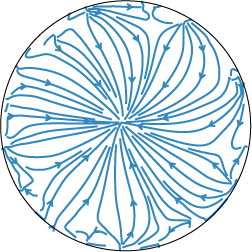
Modeling: Emergent Surface Activity Synchronization and Coherent Fluid Flow in Spherical Cavity

During embryonic development, surface-bound intracellular activity generates coherent, cell-wide cytoplasmic flows. We built a minimal mathematical model in which surface activity is represented by hydrodynamically coupled rotors lining a spherical cavity. Within this model, surface activity self-organizes into coherent, spiraling wave patterns that generate robust, cell-wide flows in the enclosed cavity.  

These results reveal a robust hydrodynamic mechanism by which local surface activity can generate coherent, cell-scale flows, independent of microscopic details of the underlying activity.

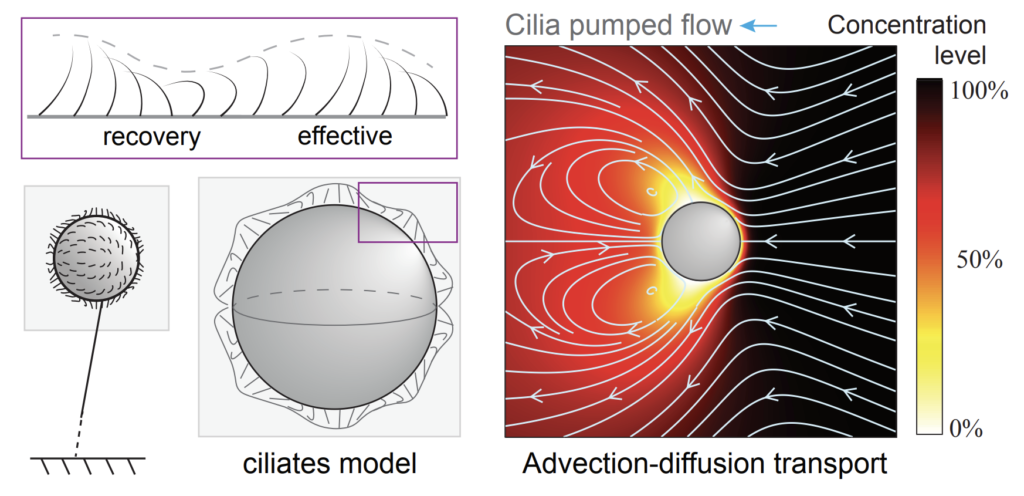
Modeling: Flow Physics in living system

Takeaways on impact of flow physics

  • Flow physics plays an important role in morphological evolution of unicellular ciliated eukaryotes.
  • Adaptive feeding strategies in ciliated microorganisms: optimal cilia motion depends on Péclet number.

Read More

Adaptive Motion Strategy:  Swimming ciliate chases and absorbs a food blob:  1. Always swim. 2. Swim, then stay.

Modeling: Collective motion in living system

Vicsek model: dynamics in 2D, periodic boundary conditions.

3-zone model: dynamics in 3D, centered obstacle

Defensive wave of Honeybees

Notes & Lectures

First passage problem

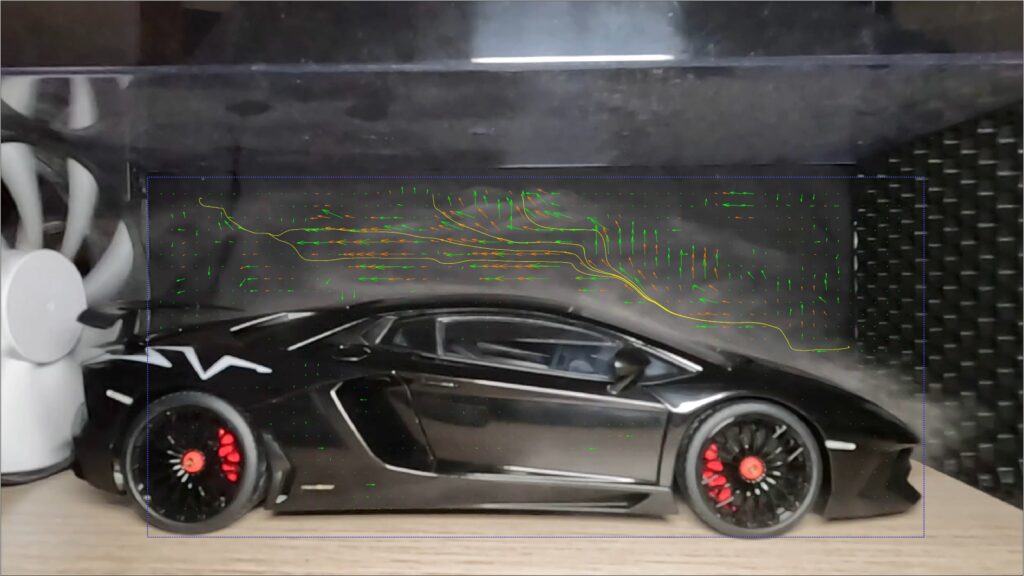
DIY Labs: Aerodynamics performance testing

Home made wind tunnel: plastic showcase, black T-shirt, battery, computer fan, GoPro, humidifier, car models

Car models: Porsche 911 GT3 RS, Lamborghini Aventado ( scale 1:18). 

PIV analysis: Matlab

Conclusion: At low speeds, the Aventador outperforms the 911 GT3 RS, making it a better choice for those navigating daily traffic congestion in downtown LA or New York City. However, further analysis is needed to assess fuel efficiency.